

A Multilingual Website Is Not a Translated Website

The most common failure I see when auditing Japanese sites built by North American companies is the “direct translation site”: the English site’s structure and copy converted into Japanese word for word. The reason these sites underperform is simple. When the language changes, search intent and search vocabulary change with it. Your American customers may search “web design,” but Japanese buyers type ホームページ制作 (homepage seisaku, literally “homepage production”). A Japanese page written around the direct equivalent of your English keyword simply never meets local search behavior. The same gap appears across services, product categories, and even basic business terms.
In other words, the real work is website localization: redesigning content around each market’s search intent, business customs, and cultural context. Translation is just 1 step inside that process. For every language you add, you need to redefine from zero who is searching, what they want, and which words they actually use. If you want to see how deep the gap runs on the search engine side, see our article Japanese SEO: Why It Is Different.
URL Structure: 3 Ways to Organize Your Japanese Pages

Option 1 is the subdirectory (example.com/ja/). All languages share the authority your existing domain has already earned, so it is the fastest path to rankings and the cheapest to operate. For most companies adding Japanese to an established English site, this should be the default.
Option 2 is the subdomain (ja.example.com). This fits when each language serves a genuinely different audience with its own strategy. JU Marketing itself is an example: our Japanese site supports Japanese companies expanding overseas, while our English site supports North American companies entering Japan. The readers and goals are different products, so we separate them by subdomain. If your Japanese site is not “the same offer in another language” but “a different audience,” the subdomain is the rational choice.
Option 3 is the country-code domain (a ccTLD such as example.jp or example.co.jp). It is the strongest geographic signal you can send, but every new domain starts from zero backlinks and zero authority. Note also that registering a .co.jp domain requires a legally registered entity in Japan, so this option usually only makes sense after you have established a local subsidiary.
The decision rule is simple. Consolidate authority and rank faster: subdirectory. Run a separate strategy for a separate audience: subdomain. Commit legally and brand-wise to Japan with a local entity: ccTLD. Evaluate them in that order.
Building a Multilingual WordPress Site

Approach 1 is plugins. Tools like Bogo, Polylang, and WPML manage language-specific posts and pages inside 1 WordPress install. Setup is straightforward and pairs naturally with subdirectory URLs. The caution: multilingual plugins are notorious for conflicts with themes and page builders, so verify compatibility with your exact stack before committing.
| TIPS: Popular WordPress multilingual plugins
Bogo: a free, lightweight option that creates 1 post per language. A good fit for smaller sites adding a single Japanese version. Polylang: a popular plugin with a free tier. It links posts, pages, and categories across languages and pairs well with subdirectory URLs. WPML: a paid, full-featured plugin with translation management and multilingual SEO settings. Common on larger corporate sites running 3 or more languages. |
Approach 2 is a translation SaaS layer that sits on top of your existing site. It is the fastest way to launch, but raw machine-translated Japanese will not carry the pages that win deals: your services, pricing, and company pages. Machine translation and unedited AI-generated Japanese fail in the same way, and both need review by a native editor before they touch a conversion page. The practical compromise is a hybrid: let automation handle informational pages, and bring Japanese website localization up to native editorial quality on every page that drives inquiries.
Approach 3 is multisite (WordPress multisite or separate installs). It pairs well with subdomain or separate-domain structures and gives each language full freedom over themes and plugins, but maintenance multiplies with every language. Choose it only with the operating capacity to match.
Whichever approach you pick, the sequence matters more than the tooling: finish your Japanese keyword research before you build the translation machinery. A perfect technical setup filled with direct-translated content just reproduces the failure pattern from the top of this article.
Hreflang and Language Switching: The Technical Foundation

3 mistakes account for most hreflang failures.
Mistake 1 is the one-way declaration. Annotating your English page with “the Japanese version is here” does nothing by itself. The Japanese page must point back to the English page, and only when both sides reference each other does Google treat them as an official language pair. Think of it like exchanging business cards: if only 1 side knows the other, no relationship exists.
Mistake 2 is forgetting visitors who match none of your languages. If your site exists in English and Japanese and a user searches from France, which version should appear? The x-default annotation designates that fallback page. Omit it and search engines have to guess, which often produces mismatched results.
Mistake 3 is the canonical tag. Each language version must declare itself as its own canonical. A surprisingly common error is pointing the Japanese pages’ canonical at the English originals, which tells Google the Japanese pages are mere copies. The result: your Japanese content disappears from search entirely.
One more decision is how users switch languages. The recommended pattern is a visible “English / 日本語” toggle in your site’s navigation, letting visitors choose. What you should avoid is forced redirects based on the visitor’s IP address. The damage goes beyond annoying a Japanese prospect who happens to be traveling in the US. Googlebot crawls primarily from US IP addresses, so a site that force-redirects all US traffic to English can prevent Google from ever crawling your Japanese pages, leaving them out of the index altogether.
What Multilingual Website Development Costs in the AI Era

An AI-first production model changes that structure. In our own production work, a corporate site build that takes a conventional multi-person team roughly 120 hours is completed in roughly 35 hours, about 3.4 times less labor, with 1 senior bilingual specialist directing AI through translation, coding, and keyword research. Those happen to be exactly the task categories where AI leverage is strongest, which is why multilingual projects benefit more than most.
Remember also that a multilingual website is never finished at launch. Each language carries ongoing content updates, rank tracking, and improvement cycles. Vendors that look cheap on the initial build are frequently overtaken on total cost once monthly translation and maintenance fees accumulate. Judge proposals on total cost of ownership, not the launch invoice.
SEO, AEO, GEO, and LLMO: Design for AI Search From Day 1
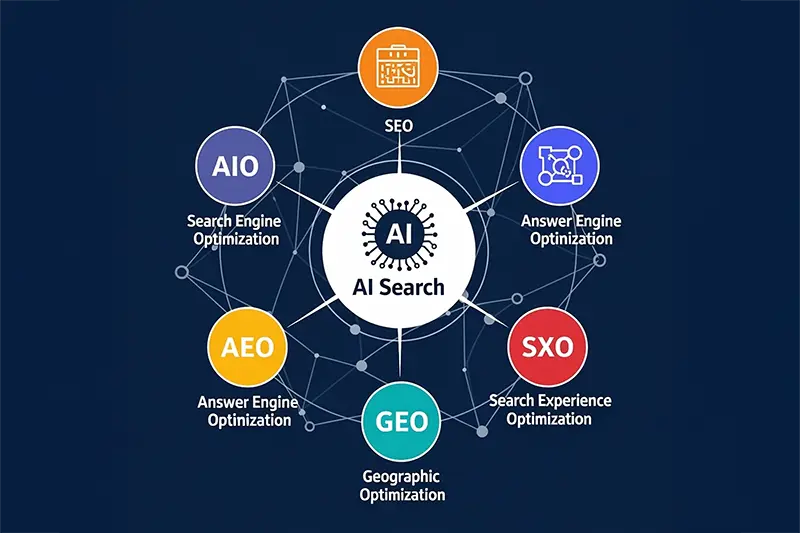
To recap the 3 points of this guide. First, multilingual website development is localization, not translation, and it starts with per-language keyword research. Second, do not cut corners on the technical foundation: URL structure (subdirectory, subdomain, ccTLD) and reciprocal hreflang. Third, judge cost on total ownership including operations, and favor production models that use AI well.
JU Marketing supports North American companies entering Japan as a senior bilingual practice: 1 specialist handling market analysis, Japanese keyword research, Japanese website development, hreflang implementation, and ongoing operations end to end. Even if you are still at the stage of “which URL structure should we choose?” or “should we localize our current site or rebuild?”, that is exactly the right time to talk. Start with a free consultation, and we will map out your route into the Japanese market together, grounded in data.
Related articles:
About JU Marketing

JU Marketing is an AI-first, senior bilingual practice helping US companies win in the Japanese market, from website build and localization to content and paid advertising. We combine AI fluency with deep Japan-market experience so your site performs across Google Japan, Yahoo! JAPAN, and AI-driven search. To talk through your Japan entry, get in touch.